Faculty layoff list
Straight ManThe Faculty layoff list is a document circulated beyond the administration during a period of budget uncertainty and threatened university-wide cuts. Although its exact contents are not reproduced, its reported existence changes the stakes of campus politics: a plan that may never be implemented nevertheless forces colleagues to consider who will be protected, who may lose work, and whom they can trust. The list becomes both a practical instrument of personnel planning and a symbol of how institutional decisions can divide a department before any cuts take effect.
Background and Purpose
The list emerges against the backdrop of a mandate to prepare for major reductions. Dickie Pope tells William Henry Devereaux Jr. that the chancellor has directed every campus executive officer to devise a plan reducing staff and costs across the curriculum by 20 percent. The plans must be drawn up, although there is no guarantee they will be implemented. The distinction between planning and execution offers no real comfort: the possibility of cuts is already shaping alliances and expectations.
The uncertainty has a financial context. Dickie explains that his budget depends on Jacob Rose’s budget, which depends on Dickie’s, while the chancellor is also waiting on funding from a legislature that has delayed action. He promises that a budget may arrive early the following week, with Dickie’s allocation expected by the end of that week. The threatened reductions therefore coexist with immediate uncertainty about ordinary departmental funding. A new Technical Careers building is also being constructed on campus, a conspicuous sign of investment that William Henry Devereaux Jr. reads uneasily alongside rumors of faculty dismissals. The juxtaposition makes the list’s underlying question harder to resolve: whether the university is preparing for genuine hardship or using efficiency and retrenchment to reshape its workforce.
Disclosure and Departmental Pressure
Paul Rourke tells William Henry Devereaux Jr. that the union has obtained a copy of the list, and clarifies that it covers every department, including the English Department. The disclosure corrects an earlier ambiguity. William Henry Devereaux Jr. had told Rourke that he had not made a list; Rourke believed that narrower claim, not that no list existed. The difference leaves open who prepared the document and how it was assembled, while confirming that personnel planning has reached beyond private administrative deliberations.
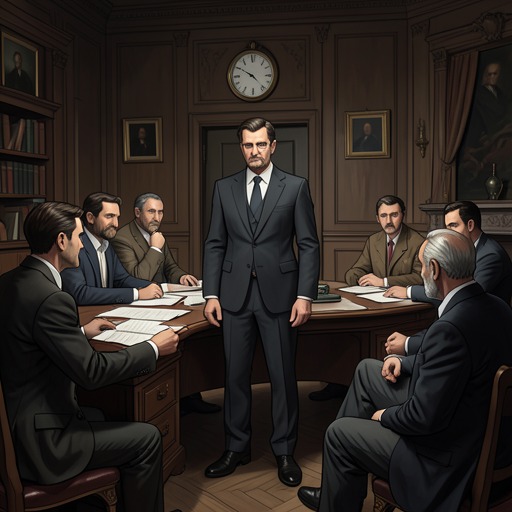
The list arrives within an increasingly coercive contest over allegiance. Herbert Schonberg tells William Henry Devereaux Jr. that the union wants him on its side, both because it regards its cause as right and because it could use his public visibility and influence. The English Department has more votes than any other department, and Herbert imagines William Henry Devereaux Jr. as a potential point person. He also reveals that Teddy Barnes and June Barnes have already spoken with him and may be aligning with the union. The appeal to join is therefore also a warning: colleagues and friends may already be taking sides against him.
Herbert asks directly which side William Henry Devereaux Jr. will support. He can join the union, cooperate with Dickie Pope, or try to remain a rogue unaffiliated with either camp. Herbert presents neutrality as dangerous, while the very act of asking for a commitment shows how the list has transformed administrative planning into a test of loyalty. The threat of layoffs does not merely identify possible losses; it makes relationships, votes, and access to decision-makers part of the struggle over who bears them.
The English Department and the Unnamed Roster
Paul Rourke indicates that three of the four people associated with the English Department’s threatened cuts are predictable, then names Orshee when William Henry Devereaux Jr. asks who is included. The exchange confirms that the list has a departmental dimension, but does not disclose its full contents. Later, Jacob Rose describes possible personnel outcomes within the same budget struggle: Orshee will have a year to find another position; Finny will receive a year’s sabbatical at half pay to finish his dissertation at Penn, with the possibility of later adjunct teaching; and Billy Quigley will be offered a job in university publications when Walter retires.
Jacob’s account leaves William Henry Devereaux Jr. as the remaining figure in the conversation about the department’s fate. He asks what should be done with him, turning a staffing discussion into a personal confrontation. William Henry Devereaux Jr. realizes that Jacob has been operating with information or leverage he did not have, and suspects that Jacob’s own role in the decisions bears on their friendship. The scene does not provide a complete copy of the list or establish that every personnel outcome Jacob describes is a direct entry on it. It does show how the prospect of reductions is experienced: through individual careers, improvised alternatives, and the suspicion that some people have already negotiated their way to safety.
Uses, Limits, and Consequences
The list’s force comes partly from the difference between a required plan and an enacted cut. Dickie tells William Henry Devereaux Jr. that no implementation is guaranteed, and frames the reduction mandate as systemwide rather than his personal initiative. He argues that administrators will absorb blame while the department chair can emerge relatively unscathed, even benefit from the removal of people he considers unproductive. His language of a leaner, more efficient institution recasts threatened dismissals as a potential gain for students and taxpayers. The list thus becomes a tool of persuasion as well as planning: it helps make a severe reduction sound like a managerial necessity and invites William Henry Devereaux Jr. to imagine himself as a beneficiary rather than a target.
The union, meanwhile, treats the same threat as grounds for collective action. Herbert Schonberg wants William Henry Devereaux Jr. to help rally the English Department, while Paul Rourke later reports that Herbert is calling for a strike vote near the end of the term. Rourke explains that the strike could prevent seniors from graduating, making the timing itself a source of leverage. These competing strategies expose the costs of the crisis: administrators seek to prepare for cuts and manage opposition, while union organizers use the possibility of disruption to resist them.
The conflict persists even as the institution’s leadership changes. After Dickie Pope is dismissed and Jacob Rose becomes chief executive officer, faculty members vote overwhelmingly against a strike, despite the union’s position and the interests of faculty who would be affected by the following year’s budget cuts. That decision does not make the list irrelevant or prove that its threatened reductions have been resolved. Instead, it marks a change in the political conditions under which they are faced: the faculty reject the proposed strike after learning of the new leadership, while colleagues identified as vulnerable still confront uncertain prospects.
Significance
The Faculty layoff list is never presented as a fully legible document. Its contents are conveyed through conversations, hints, and the consequences people anticipate, so the reader encounters it less as a stable roster than as a source of pressure. Its partial visibility mirrors the power imbalance surrounding it: people must choose sides and imagine outcomes without possessing complete information. The document’s secrecy makes rumor consequential, while its reported possession by the union shows that administrative planning cannot remain neatly contained within management.
The list also connects two vocabularies for the university’s future. Dickie Pope speaks in terms of efficiency, reduced costs, and institutional survival; union advocates speak in terms of solidarity, votes, and resistance. The same prospective cuts can be presented as the pruning of deadwood or experienced as a threat to particular careers and to collective bargaining power. Because the mandate requires a plan but does not guarantee its implementation, the list occupies an unstable space between forecast and decision. Its consequences begin before any final cuts: friendships become politically charged, the department is pressed to align, and uncertainty itself becomes an instrument of institutional power.